
















Why Does Lakshmi Love Cleanliness? The Spiritual Significance of Cleanliness in Hinduism
Discover why Goddess Lakshmi loves cleanliness according to Hindu traditions. Learn the spiritual significance of a clea...
Read More

 'Narad Puran' is called as Vaishnav Puran because like Shrimad Bhagwat and Vishnu Puran, its theme also is devotion to Vishnu. The gist of all of the eighteen Purans is narrated in this Puran. Besides there is detailed analysis of mythological and educative descriptions, the stories related with the important vrats of the twelve months, its method of worship, glory of ekadashi (eleventh day of a month) vrat, the science of mantra and astrology, the glory of holy Ganga and pilgrim spots situated at her bank, etiquettes and dharma of varnashram, stories inspiring devotion, and the spiritual philosophy.
This Puran begins with the five questions raised before Sootji by rishi-munis:
1. Which is the easiest method to please Lord Vishnu?
2. What is the benefit of devotion and what should be the appearance of the devotees of God?
3. How can man attain emancipation (moksha)?
4. What is the actual form of varnashram?
5. How should guests be received?
The gist of the answers of these questions as offered by Maharshi Lomharshan Sootji is as follows:
1. The easy way to realize Lord Vishnu lies in observing reverence, devotion, and good conduct.
2. Lord Vishnu's blessings are obtained through devotion. This is the greatest reward of life. Those have been said to be true devotees who observe selfless devotion to Lord Vishnu.
3. Man can achieve closeness to God which means that he can attain emancipation (moksha) by dedicating his mind in Shri Vishnu's feet through selfless devotion by regulating his senses.
4. There have been said to be four varna - Brahmin, Kshatriya, Vaishya, and Shudra; and there have been said to be four ashrams - brahmcharya, grihastha, vaanprastha, and sanyas. The duty of Brahmin is to do yajna and rituals, Kshatriya has to protect people, for Vaishya business etc., and Shudra has to serve the three class of the people mentioned above. Among ashrams, brahmcharya should be observed with special strictness and the grihastha should take care of the men in other three ashrams.
5. Guest should be given great reception as if he is the real God.
It is evident from the above statements that the human values, the related rules, actions and dharma have been analysed in detail in the Narad Puran. Besides Vishnu's worship, there is description of method of mantra and worship of Shri Ram, Hanuman, Krishna, Kali, and Shiv in this Puran. Number of Verses and Sections
There are twenty-five thousand (25,000) verses in Narad Puran. The total Puran is divided into two sections - first part and second part. There are one hundred and twenty-five chapters in the first part and eighty-two chapters in the second part. Thus the entire Narad Puran is narrated in two hundred and seven (207) chapters.
Structure and Composition
The Narad Puran is divided into two parts with a total of 25,000 verses (shlokas). These verses are composed in the form of conversations between Sage Narada and other sages, describing the glory of Vishnu, creation of the universe, and paths to liberation.
First Part (Purvabhaga): Discusses cosmology, creation, geography of the universe, and religious observances.
Second Part (Uttarabhaga): Focuses on Bhakti Yoga, importance of pilgrimages, and various hymns dedicated to Vishnu and his incarnations.
Key Teachings of Narad Puran
Supremacy of Lord Vishnu: Lord Vishnu is described as the supreme reality and protector of the universe.
Bhakti as the Highest Path: Devotion and surrender to God are emphasized over rituals and knowledge alone.
Moral Conduct: It advocates truthfulness, compassion, and non-violence.
Pilgrimage and Rituals: Describes the importance of holy sites like Dwarka, Mathura, and Jagannath Puri.
Festivals: Explains the significance of Ekadashi, Janmashtami, and Vaikuntha Ekadashi.
Famous Stories from the Narad Puran
The Purana contains inspiring tales like:
Stories of Lord Krishna’s childhood leelas
The Samudra Manthan (Churning of the Ocean)
The glory of Tulsi plant and its worship
Prahlada’s devotion to Lord Vishnu despite adversity
Religious and Cultural Significance
The Narad Puran not only imparts spiritual wisdom but also guides devotees on how to live harmoniously in society. Its narratives have influenced temple rituals, art, dance, and devotional music. It also preserves important Vaishnav traditions that continue to be followed today.
Explore Vedic Astrology, Numerology, Vastu, Panchang, Nakshatras, Ayurveda, Mantras and Spiritual Wisdom.
Personalized astrology consultations, predictions and remedies prepared by experienced Vedic astrologers.
Explore hand-picked articles related to this topic to deepen your astrological knowledge.
Discover why Goddess Lakshmi loves cleanliness according to Hindu traditions. Learn the spiritual significance of a clea...
Read More
Discover the important things to avoid during Shravan Maas according to Hindu traditions. Learn the spiritual significan...
Read More
Discover the story of Lord Kamadeva, the Hindu God of Love and Desire. Learn about his origin, symbolism, marriage to Ra...
Read More
Discover the spiritual significance of Navratri in Hinduism, the nine forms of Maa Durga, Navadurga worship, fasting, Ka...
Read More
Discover why Muhurat played a vital role in ancient Indian culture. Learn the spiritual, astronomical, and scientific si...
Read More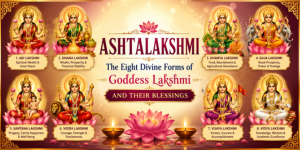
Discover the sacred Ashtalakshmi, the eight forms of Goddess Lakshmi who bestow wealth, prosperity, courage, knowledge, ...
Read More