
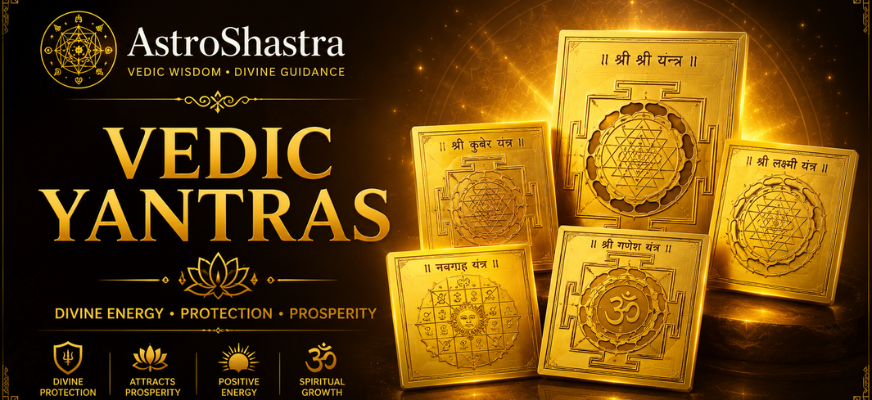
Vedic Yantras – Meaning, Types, Benefits & Traditional Uses
Explore the traditional meaning, types, benefits, uses, placement and worship of Vedic Yantras. Learn how sacred geometric designs are associated with deities, planets, prosperity, protection, Vastu, meditation and spiritual practices.
Vedic Yantras are sacred geometric diagrams traditionally used in Indian spiritual, devotional and astrological practices. They are associated with specific deities, mantras, planets and spiritual intentions and are used as objects of worship, meditation and focused contemplation.
Different Yantras are traditionally associated with different purposes. Some are connected with prosperity and abundance, while others are associated with protection, success, knowledge, planetary influences, Vastu, meditation and spiritual development. The purpose of a Yantra depends on its specific design, deity association and the tradition in which it is used.
At Astroshastra, we offer a wide range of Yantras in different forms and materials, including copper, silver, gold-plated and Bhojpatra Yantras. Explore the different types of Vedic Yantras below and learn about their traditional significance, benefits, methods of worship and suitable uses.
What Is a Vedic Yantra?
The word Yantra is traditionally understood as an instrument, device or means of support. In spiritual practice, a Yantra is a sacred geometric representation used to focus the mind and support meditation, prayer and worship.
Traditional Yantras may contain geometric forms such as triangles, circles, squares, lotus petals and a central point known as the Bindu. Each element may carry symbolic significance within the particular spiritual tradition associated with the Yantra.
Yantras are traditionally connected with specific deities, mantras, planetary energies or spiritual objectives. They may therefore be used as a visual focus during mantra chanting, meditation and devotional practice.
Significance of Yantras in Vedic Tradition
Yantras occupy an important place in several traditional Indian spiritual and Tantric practices. They are regarded as visual representations of subtle principles and are often used together with mantra and ritual worship.
A Yantra is traditionally considered more than a decorative geometric design. Its significance comes from the combination of sacred geometry, symbolism, mantra, deity association, intention and the method of worship followed by the practitioner.
Traditional Yantras can be drawn, engraved, painted or created on different materials. Gold, silver, copper, Bhojpatra and other traditional surfaces have been used for different forms of Yantra practice.
How Do Yantras Work?
In traditional practice, a Yantra provides a visual point of concentration. A practitioner may focus on its geometric structure while reciting an associated mantra or performing meditation and prayer.
The geometric arrangement of the Yantra is traditionally regarded as a symbolic representation of particular cosmic, divine or spiritual principles. The central Bindu represents a point of concentration and is an important element in many Yantric designs.
Yantra practice is generally combined with other spiritual disciplines such as mantra chanting, meditation, prayer and devotional rituals. The method of use can differ according to the particular Yantra and the tradition being followed.
Benefits of Vedic Yantras
The benefits attributed to Yantras are based on traditional spiritual, religious and astrological beliefs. Different Yantras are associated with different intentions and therefore there is no single benefit common to every Yantra.
Prosperity and Abundance
Certain Yantras are traditionally associated with Goddess Lakshmi, Lord Kubera and other forms of prosperity and abundance.
Protection
Several protective Yantras are traditionally worshipped for spiritual protection, courage and a sense of security.
Success and Achievement
Some Yantras are associated with overcoming obstacles, determination, achievement and progress.
Peace and Mental Focus
Yantras may be used as visual objects of concentration during meditation and prayer.
Spiritual Development
Regular Yantra worship may form part of a disciplined spiritual practice involving meditation, mantra and devotion.
Planetary Remedies
Specific planetary Yantras are traditionally used as part of astrological remedial practices.
Vastu Harmony
Certain Yantras are traditionally used in Vastu-related spiritual practices for maintaining harmony and balance within a space.
Devotional Practice
A Yantra can provide a symbolic and visual focus for prayer, mantra recitation and regular devotional practice.
Different Types of Vedic Yantras
There are many types of Yantras, and each has its own traditional symbolism and purpose. Some are associated with particular deities, while others are connected with the Navgrahas, Vastu or specific spiritual objectives.
Shree Yantra
Shree Yantra is one of the most widely known sacred geometric diagrams and is traditionally associated with Goddess Tripura Sundari and the principles of prosperity, abundance, spiritual balance and divine consciousness.
Mahalakshmi Yantra
Mahalakshmi Yantra is traditionally associated with Goddess Lakshmi and is worshipped with intentions related to prosperity, abundance, financial well-being and auspiciousness.
Kuber Yantra
Kuber Yantra is traditionally associated with Lord Kubera, the deity of wealth and abundance. It is commonly used in devotional practices connected with prosperity and financial stability.
Ganesh Yantra
Ganesh Yantra is traditionally associated with Lord Ganesha and is used in worship for auspicious beginnings, wisdom, success and overcoming obstacles.
Navgraha Yantra
Navgraha Yantra represents the nine planetary influences in traditional Vedic astrology. It may be used as part of spiritual and astrological practices associated with planetary balance.
Baglamukhi Yantra
Baglamukhi Yantra is traditionally associated with Goddess Baglamukhi and is used in specific devotional practices related to protection, courage, victory and overcoming adversarial situations.
Mahamrityunjaya Yantra
Mahamrityunjaya Yantra is traditionally associated with Lord Shiva and the Mahamrityunjaya mantra. It is used in devotional practices connected with protection, spiritual strength and well-being.
Vastu Yantras
Vastu Yantras are traditionally used in Vastu-related practices. Depending on the specific Yantra, they may be associated with harmony, balance, positive intentions and spiritual protection within a property.
Yantras for Wealth and Prosperity
Several Yantras are traditionally associated with wealth and prosperity. Shree Yantra, Mahalakshmi Yantra, Kuber Yantra, Kanakdhara Yantra and Mahalakshmi Kuber Yantra are examples of Yantras commonly worshipped for abundance and financial well-being.
Choosing a Prosperity Yantra
The appropriate Yantra depends on the individual's purpose and the tradition being followed. A Yantra should not be considered a guaranteed method of generating wealth; rather, it may be incorporated into a devotional or spiritual practice.
Yantras for Protection
Protection Yantras are traditionally associated with spiritual strength, courage and protection from perceived negative influences. Different protective Yantras have different deity associations and methods of worship.
Baglamukhi Yantra, Durga Yantra, Hanuman Yantra, Bajrang Yantra, Narsingh Yantra and Bhatuk Bhairav Yantra are among the traditional Yantras associated with protective spiritual practices.
Planetary Yantras and Astrology
Planetary Yantras are used in traditional Vedic astrology as one form of remedial practice. Individual planetary Yantras may be associated with the Sun, Moon, Mars, Mercury, Jupiter, Venus, Saturn, Rahu and Ketu.
A planetary Yantra may be selected according to the astrological objective and the planetary influence being considered. For personalized remedial purposes, the horoscope and the complete planetary condition should be considered rather than choosing a Yantra solely from a general description.
Yantras for Meditation and Spiritual Growth
Yantras can serve as visual aids for meditation. The structured geometric design provides a fixed point of attention and may help practitioners develop concentration and devotional awareness.
Meditation on a Yantra is traditionally performed along with mantra recitation, controlled breathing, prayer or other spiritual practices. Regularity and sincerity are generally considered important aspects of such practices.
How to Use a Vedic Yantra
The exact method of using a Yantra varies according to the specific Yantra, its deity association and the tradition being followed. A simple devotional practice may include the following steps:
Keep the Yantra in a clean and respectful place such as a home temple, Puja area or meditation space.
Clean the surrounding worship area before beginning your devotional practice.
Place the Yantra on a suitable clean surface or altar according to its traditional use.
Light a diya or incense according to your customary Puja practice.
Offer flowers or other appropriate devotional offerings if desired.
Recite the associated mantra with concentration and sincerity according to your tradition.
Meditate upon the Yantra and its central Bindu for a few minutes with focused attention.
For specialized Yantras and elaborate rituals, the prescribed method may include additional purification, installation, mantra and worship procedures.
Where Should a Yantra Be Placed?
Yantras are traditionally kept in clean and respectful locations such as a home temple, Puja room, meditation area, office or workplace. The ideal placement can vary according to the particular Yantra and its purpose.
Some Yantras are traditionally associated with specific directions or locations. Therefore, generalized placement advice should not be applied to every Yantra in exactly the same way.
How to Choose the Right Yantra?
Choosing a Yantra begins with identifying the purpose for which it is being considered. A person looking for a devotional focus connected with prosperity may consider a prosperity-related Yantra, while someone interested in planetary remedies may consider a planetary Yantra.
For astrological purposes, the choice may be influenced by the individual's birth horoscope, planetary strengths and weaknesses, current Dasha, transits and the specific remedial objective.
When you are unsure which Yantra is appropriate, consulting an experienced astrologer or knowledgeable practitioner can help you understand the traditional options before making a selection.
What Is Yantra Energization or Pran Pratishtha?
Pran Pratishtha is a traditional ritual process associated with establishing a sacred presence in an object used for worship. In Yantra practice, energization may involve purification, mantra chanting, invocation and other prescribed rituals.
The exact process differs according to the Yantra, deity and spiritual tradition. Therefore, claims that every Yantra must follow one identical energization procedure are not appropriate.
An energized Yantra is traditionally treated as a sacred object of worship and is expected to be maintained with appropriate respect and devotional practice.
Yantra Materials: Copper, Silver, Gold & Bhojpatra
Traditional Yantras can be prepared on different materials, depending on the particular Yantra and method of practice. Copper, silver, gold, Bhojpatra and other traditional surfaces have been used in different contexts.
| Material | Traditional Context |
|---|---|
| Copper | One of the commonly used traditional surfaces for engraved and worship Yantras. |
| Silver | Traditionally used for certain Yantras and devotional objects associated with purity and worship. |
| Gold / Gold Plated | Used for premium Yantra forms and traditionally associated with auspiciousness and prosperity. |
| Bhojpatra | A traditional natural writing surface used in certain spiritual and Yantra practices. |
The material itself does not replace the spiritual significance of the Yantra. The design, associated deity, mantra, method of preparation and intended use are all important parts of traditional Yantra practice.
How to Maintain a Yantra
Keep It Clean
Keep the Yantra in a clean and respectful location and maintain the worship area properly.
Protect From Damage
Protect it from unnecessary dust, moisture and physical damage.
Avoid the Floor
Avoid placing a sacred Yantra directly on the floor.
Handle Respectfully
Handle the Yantra respectfully during cleaning, movement or worship.
Continue Devotional Practice
Continue the associated mantra or prayer practice according to your tradition.
Can Yantras Be Used Along With Mantras?
Yes. Yantra and mantra are traditionally used together in many spiritual practices. The Yantra provides a visual focus, while the mantra provides the sound component of the practice.
The specific mantra associated with a Yantra depends on the deity, tradition and purpose. Those following a particular spiritual lineage should use the mantra and procedure prescribed by that tradition.
Yantra, Mantra and Tantra – Understanding the Difference
Yantra, Mantra and Tantra are related concepts in several Indian spiritual traditions, but they are not identical.
Yantra
A Yantra is primarily a sacred geometric or symbolic diagram used as a visual focus in spiritual, devotional and meditative practices.
Mantra
A Mantra is a sacred sound, word or formula used in prayer, meditation or spiritual practice.
Tantra
Tantra refers to broader systems of spiritual practice, philosophy and ritual traditions.
In many traditional practices, these three elements may be used together, depending on the particular spiritual lineage.
Frequently Asked Questions About Vedic Yantras
What is a Vedic Yantra?
A Vedic Yantra is a sacred geometric diagram traditionally used for worship, meditation, mantra practice and spiritual contemplation. Different Yantras are associated with different deities, planets and spiritual purposes.
What are Yantras used for?
Yantras are traditionally used for meditation, worship, spiritual focus, planetary remedies, prosperity, protection, success, Vastu-related practices and other specific devotional purposes.
Do all Yantras have the same benefits?
No. Different Yantras have different traditional associations. A Shree Yantra, planetary Yantra, protection Yantra and Vastu Yantra may have different purposes and methods of worship.
Can Yantras be kept at home?
Yes. Yantras may traditionally be kept in a clean and respectful place such as a home temple, Puja room or meditation area.
Can I worship more than one Yantra?
It is possible to keep and worship multiple Yantras, but the appropriate combination depends on the purpose and tradition. When combining several Yantras, it is advisable to understand their individual worship methods and associations.
Which Yantra is best for wealth?
Shree Yantra, Mahalakshmi Yantra and Kuber Yantra are traditionally associated with prosperity and abundance. The most appropriate choice depends on the individual's purpose and, where relevant, astrological considerations.
Which Yantra is used for protection?
Several Yantras are traditionally associated with protection, including Durga Yantra, Hanuman Yantra, Baglamukhi Yantra, Narsingh Yantra and Bhatuk Bhairav Yantra. Their traditional purposes and methods of worship are different.
Do Yantras need to be energized?
Traditional practices may prescribe purification and energization for certain Yantras. The exact process depends on the specific Yantra and the tradition being followed.
Can Yantras help with meditation?
Yes. Traditionally, Yantras are used as visual objects of concentration during meditation and prayer. Focusing on their geometric patterns can become part of a regular spiritual practice.
How should I choose a Yantra?
Choose a Yantra according to your intended purpose and the traditional association of that Yantra. For astrology-based remedies, a qualified astrologer can assess the horoscope before recommending a particular planetary or remedial Yantra.
Explore More About Vedic Yantras
Learn more about specific Yantra purposes, traditional practices and different types of Yantras through our detailed Yantra resources.
- Yantra for Money and Success
- Best Yantra for Business Growth
- Yantra for Job and Career
- Which Yantra Attracts Wealth
- Yantra for Protection from Negative Energy
- Yantra for Evil Eye Removal
- Yantra for Love and Marriage
- Yantra for Meditation and Spiritual Growth
- How Yantras Help in Spiritual Awakening
- Difference Between Yantra, Mantra and Tantra
- How Yantras Work – Science or Belief
- History of Vedic Yantras
- Yantra Rules and Mistakes to Avoid
- Benefits of Yantras
- Types of Yantras
Find the Right Yantra for Your Purpose
Choosing a Yantra can depend on your spiritual intention, devotional practice and, for astrological remedies, your individual horoscope. Explore our collection of traditional Yantras or seek guidance when you need a personalized remedy.
Consult AstroshastraPowerful Sacred Yantras
Energized Yantras for prosperity, protection, success, health, spiritual growth and removal of planetary obstacles.

Ashtavinayak Ganesh Yantra
Invokes Lord Ganesha's blessings for success, prosperity and obstacle removal.
View Details
Navgrah Yantra
Balances planetary energies and helps reduce malefic planetary influences.
View Details
Mahamrityunjay Yantra
Powerful protection yantra for health, healing and positive life energy.
View Details
Vastudosh Nivaran Yantra
Helps neutralize Vastu defects and attract harmony, peace and prosperity.