


5 Lakshmi Mantras for Prosperity: Meaning & Chanting Method
Discover 5 traditional Lakshmi mantras for prosperity, their meanings, pronunciation, devotional significance and a simp...
Read More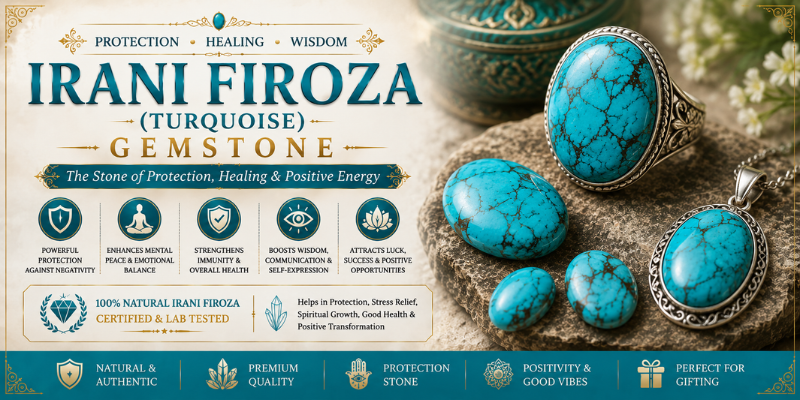

Turquoise is an opaque gemstone that commonly occurs in shades ranging from sky blue and blue-green to green. It has been valued for thousands of years and has a long history of use in jewellery, ornamentation and spiritual traditions.
The gemstone is also known by names such as Firoza, Firoza Stone and Irani Firoza. The term Turquoise is associated historically with Turkey and the trade routes through which the gemstone became known in Europe.
Natural Turquoise can contain matrix patterns and variations in colour. Its appearance can range from relatively uniform blue to blue-green or green material with naturally occurring matrix.
Iranian Turquoise has a long-standing reputation in the gemstone trade. Fine material from Iran has traditionally been appreciated for its attractive blue colour and distinctive appearance.
Turquoise is also found in several other parts of the world, including the United States, Mexico, Tibet, Australia and Chile. The colour, matrix pattern and quality can vary considerably according to the origin and individual gemstone.
The blue colour of Turquoise is associated with copper, while iron can contribute to greener shades. Natural Turquoise is generally opaque rather than transparent.
Turquoise has been used in different cultural and spiritual traditions as a gemstone associated with protection, courage, communication, tranquillity and positive intentions.
Its astrological associations can vary between different gemstone traditions. Therefore, if you are considering Firoza specifically as an astrological remedy, it is better to have your birth chart analysed rather than choosing the gemstone solely on the basis of a general birthstone list.
Astroshastra offers personalised gemstone guidance for people who want to understand which gemstone may be appropriate for their horoscope.
In traditional gemstone and crystal practices, Turquoise is associated with a number of positive qualities. These associations should be understood as traditional beliefs and symbolic uses, rather than guaranteed medical or life outcomes.
Traditionally regarded as a protective gemstone and often worn as a symbolic talisman.
Traditionally associated with calmness, tranquillity and emotional balance.
Commonly associated with communication, self-expression and clarity in traditional crystal practices.
Traditionally used by people interested in meditation, spirituality and inner awareness.
Historically associated with courage, confidence and positive personal expression.
Symbolically connected with harmony, compassion and emotional well-being.
One of the strongest traditional associations of Turquoise is with communication and self-expression. In crystal traditions, it is often connected with the throat chakra and is therefore chosen by people interested in improving their symbolic connection with communication and expression.
This traditional association has contributed to the popularity of Turquoise among people involved in communication, creative expression and spiritual practices.
Turquoise has a long history as a protective talisman. Across different cultures, it has traditionally been carried or worn as a symbolic stone of protection and good fortune.
Historical traditions have associated Turquoise with protection during travel, courage and safeguarding the wearer from negative influences. These are cultural and traditional beliefs rather than scientifically established effects.
In crystal healing traditions, Turquoise is commonly associated with the throat chakra. It is symbolically linked with communication, self-expression and speaking with clarity.
It is therefore frequently selected for meditation, spiritual practices and personal intention work related to communication and emotional expression.
Turquoise may appeal to people who appreciate its distinctive blue-green colour, historical significance and traditional associations with protection, communication, tranquillity and spiritual awareness.
It is also widely used as a jewellery gemstone in rings, pendants, bracelets and other ornaments.
If you want to wear Turquoise specifically for an astrological purpose, the gemstone should be selected after examining your individual horoscope. A gemstone that is suitable for one person may not necessarily be suitable for another.
Get your horoscope analysed and receive personalised gemstone guidance based on your planetary positions and astrological requirements.
Consult an Astro ExpertThe method of wearing Turquoise depends upon the purpose for which the gemstone has been selected. If it is being worn as jewellery, the choice of ring, pendant or bracelet can be based on personal preference.
If Firoza is being selected as an astrological remedy, the gemstone weight, metal, finger, day and method of wearing should ideally be determined according to the individual's horoscope.
Rather than following a single universal rule, personalised astrological guidance can help determine whether Turquoise is appropriate for your particular birth chart.
Natural Turquoise can show variations in colour, matrix, texture and overall appearance. These characteristics are natural features of the gemstone and can help make each stone unique.
When buying Turquoise, it is important to consider the stone's authenticity, quality, treatment information and certification. A certified gemstone offers greater confidence about the stone being purchased.
Astroshastra Gemstore provides gemstone options for customers looking for natural and certified gemstones for jewellery, collection or traditional gemstone purposes.
Explore Turquoise, Firoza and Irani Firoza gemstones available through Astroshastra Gemstore.
Explore Certified Turquoise GemstonesTurquoise has traditionally been associated with calmness, confidence, communication and spiritual awareness. These associations have made it popular among people who use gemstones as part of meditation, personal reflection and spiritual practices.
Its distinctive blue-green colour also makes Turquoise a popular choice for jewellery and gemstone collections.
Turquoise has historically been obtained from several regions. Iran is particularly well known for its traditional Turquoise, while significant deposits have also been found in the United States, Mexico, Tibet, Australia and other locations.
Turquoise from different sources can vary in colour, matrix and appearance. Fine blue material has traditionally been highly valued, while greener varieties are also widely available.
Turquoise is traditionally recognised as a birthstone in several modern gemstone traditions. Its blue-green colour and long historical association with protection and good fortune have made it a popular birthstone.
However, a birthstone recommendation and an astrological gemstone recommendation are not necessarily the same. If you are looking for a gemstone as an astrological remedy, your horoscope should be considered separately.
Discover Natural, Certified & Energized Gemstones for Health, Prosperity, Career, Marriage and Planetary Remedies.
Discover 5 traditional Lakshmi mantras for prosperity, their meanings, pronunciation, devotional significance and a simp...
Read More
Discover the Kojagari Lakshmi Puja significance, the spiritual meaning of the Sharad Purnima night vigil, regional tradi...
Read More
Prepare for Diwali 2026 with our complete Diwali puja samagri list, including Lakshmi-Ganesh Puja items, offerings, diya...
Read More
Discover the Lakshmi Ganesha Diwali significance and learn why Goddess Lakshmi and Lord Ganesha are worshipped together ...
Read More
Prepare for Diwali 2026 with this 17-day guide to home cleaning, Vastu-inspired practices, spiritual reflection, Lakshmi...
Read More
Explore 9 traditional Vastu tips after Dussehra to refresh your home through decluttering, natural light, entrance care,...
Read More