
















Navratri in Hinduism – Why Nine Nights Are Spiritually Important
Discover the spiritual significance of Navratri in Hinduism, the nine forms of Maa Durga, Navadurga worship, fasting, Ka...
Read More


2. Prakriti Khand
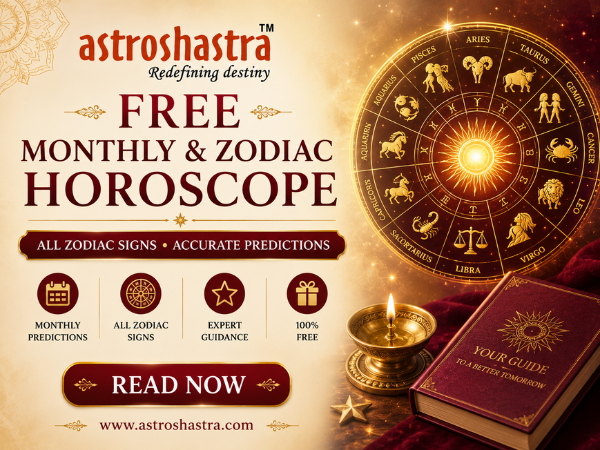
This khand of Brahmvaivart Puran comprises 47 chapters. It begins with the description of the five-goddess forms of nature (prakriti) - Durga, Lakshmi, Saraswati, Gayatri, and Radha. ‘Pra' means superior and 'kriti' means creation. Which means the goddesses equipped with superior abilities who are capable in creation are called 'prakriti' (nature). The parbrahm produced himself in the two forms namely purush and prakriti at the beginning of the creation. After that a fraction of prakriti separated to become Durga according to the wish of Lord Shri Krishna and became dear to Lord Shiv. The embodiment of all the power, Bhagwati Durga is ruler of all the accomplishments. Worshipped by gods and rishi-munis, goddess Durga salvages them who take refuge in her and provides them fame, affluence, punya, and emancipation.
Emerged from the fraction of prakriti, and the force behind Lord Vishnu, Goddess Mahalakshmi is the ruler of wealth. Mahalakshmi is called Swarg Lakshmi for residing in paradise, Raj lakshmi for residing at kings, and Grihlakshmi for residing in houses.
The goddess of intelligence, education, and knowledge, Saraswati is said to be the voice of supreme soul (paramatma). This goddess provides intelligence, wisdom, brilliance, and memory, and provides the power of imagination through enlightening the difference between principles and its meaning.
Goddess Gayatri has been said to be the fourth prakriti goddess. She is the mother of Bodhgamya, Ved-Vedang, Chhand and scriptures fox Brahmins, Kshatriyas, and Vaishyas. Dear to Brahmaji, Gayatri has another name- Savitri. This goddess, identical to parbrahm, grants emancipation.
The fifth and last prakriti goddess is Radha who is dear to Shri Krishna and lives on the left side of Lord Shri Krishna. She is identical to parbrahm in virtues and is revered in all the loks. She is said to be the goddess of ras (romance).
Thus these five goddesses are complete in themselves. There are various forms of these goddesses namely main fraction, important and histrionic fraction. For example, Ganga, Tulsi, Vasundhara, Manasa, Mangalchandi, Khashthi (Devsena), and Mahakali etc. have emerged from the main fraction of the five goddesses; Dakshina, Deeksha, Swaha, Swadha, Swasti, Tushti, Dhriti, Kshama, Rati, Mukti, Pratishtha, Kirti, Priya, Daya, Mithya, Shanti, Lajja, Buddhi, Medha, Smriti, and Murti etc. have emerged from the important fraction of the five goddesses; and Sita, Rukmini, Rohini, Tara, Lopamudra, Arundhati, Ahalya, Ansuya, Devbhuti, Prasuti, Ahuti, Varunaani, Mena, Shachi, Damyanti, Yashoda, Devaki. Kalawati. Draupadi, Gandhari, Saivya, Kaushalya, Subhadra, Rewati, Satyabhama, Renuka, etc. are said to be the histrionic fraction of the five goddesses.
After the brief introduction of the wives of all the main gods, there is description of the method of worship of Saraswati, the world-winning armour of Saraswati, and the prayer of Goddess Saraswati by Maharshi Yagvalkya. Thereafter the episode of Saraswat, Ganga, and Lakshmi invoking curse upon one another and descend of Saraswati and Ganga on the earth as river as the result of the curse is described. In this context, the episodes of birth of Lakshmi as Tulsi on the earth as a result of the curse of Saraswati, marriage of Tulsi and Shankhchud, assassination of Shankhchud, to attack upon the faithfulness (satitva) of Lakshmi, and Shri Vishnu staying back on the earth as tree and Shaligram rock are described. After that there is description of the worship, meditation, namashtak and stavan of Tulsi.
The story of Goddess Saraswati has been described in the 23rd chapter. Worship of Goddess Savitri (Gayatri) by King Ashwapati and his wife Malati, and detailed analysis of the glory of Gayatri by Maharshi Parashar has been made in it. There are episodes of fraction of Goddess Savitri taking birth from the womb of Malati, the wife of Ashwapati, marriage of Savitri and Satyavan, resurrection of Satyavan by Yamraj pleased by the faithfulness (pativrat) of Goddess Savitri. In this Puran there is description of the holy vrat alongwith the method of worship observed by Savitri for fourteen years.
After the glory of Savitri, the story of the emergence of Mahalakshmi from the left part of Lord Shri Krishna and her departure to Vaikunthlok with Lord Vishnu has been told. In this context, the mythological stories of disrespect of Durwasa muni by Devraj Indra, invocation of curse on Indra by furious Durwasa muni and, as a result of curse, disappearance of Goddess Lakshmi and her reappearance during the churning of the ocean are described.
After that there are stories of producing Swaha for fire (agni), Swadha for forefathers, and Dakshina foryajna-purush by Lord Shri Krishna. In this very sequence, the stories related with Goddess Shashthi, Manasa, and Mangalchandika have been cited.
Describing the holy character of Radha-Krishna, the method of worship, meditation, shodshopchar, nursing, pariharstav worship, ant the glory of the very benevolent armour named Jag-Mangal of Shri Radha have been described in detail from the 49th to 56th chapters.
Finally there is description of the famous sixteen names of Bhagwati Durga, method of worship, the story of King Surath and vaishya named Samadhi, the special nakshatra for the worship of goddess and her stotra named Durg Nashan.
Explore Vedic Astrology, Numerology, Vastu, Panchang, Nakshatras, Ayurveda, Mantras and Spiritual Wisdom.
Personalized astrology consultations, predictions and remedies prepared by experienced Vedic astrologers.
Explore hand-picked articles related to this topic to deepen your astrological knowledge.
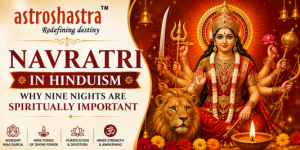
Discover the spiritual significance of Navratri in Hinduism, the nine forms of Maa Durga, Navadurga worship, fasting, Ka...
Read More
Discover powerful mantras for planets in Vedic astrology. Learn Navgraha mantras for Sun, Moon, Mars, Mercury, Jupiter, ...
Read More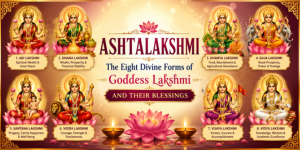
Discover the sacred Ashtalakshmi, the eight forms of Goddess Lakshmi who bestow wealth, prosperity, courage, knowledge, ...
Read More
Discover how to choose the ideal Shaligram according to your Nakshatra. Learn the spiritual significance, benefits, reco...
Read More
Vishwakarma Puja is dedicated to Lord Vishwakarma, regarded in Hindu tradition as the divine architect and craftsman....
Read More.png)
Discover the most effective astrology items for Planet Sun in Vedic Astrology. Learn about gemstones, Rudraksha, Yantras...
Read More