















Retrograde Planets Meaning in Astrology: Effects, Myths & Real Impact
Understand the meaning of retrograde planets in astrology, their effects on life, and how they influence behavior, karma...
Read More



Ascendant (the first house) is considered
to be the month of birth. If, during some year, planets in a horoscope coincide with the houses of varshaphala, the planet will put effect on that month only.
A planet will confer its effect according to the month of birth irrespective of its position in the varshaphala. For example - a planet, which was sitting in the 5th house in the birth
chart, will confer effect in the twelfth month on coming in the twelfth house in the varshaphala. The twelfth month for the native born in February will be January and the planet will
put its effect in the month of January.
Now the planets have their favourable and unfavourable effect - to know that a detailed analysis has been presented i: ?His book, of the twelve houses, the effect of planets in the
twelve houses, and nature of planets etc. To remedy the ill effect of the planets, one should not use the objects related with the planet and to secure auspicious effect one should
donate the objects of the planet.
Several strange things have been seen in Lai Kitab: for example - according to the scriptural astrology, the effect of planet, be it auspicious or inauspicious, is to be experienced
necessarily. But, accordiing to Lai Kitab, by installing related objects at various place:s you can secure the effect of those planets on the houses:
- If the planet is to be put up in ascendant - the native should adorn the object of that planet around his neck.
- If the planet is to be put up in the second house - place the object of the plamet at the temple or religious places.
- If the planet is to be put up in the third house - wear / adorn the gem / stone related with the planet on hand.
- If the planet is to be put up in the fourth house - immerse the objects related with the planet in running water.
- If the planet is to be put up in the fifth house - transfer the objects of the planet at the school / college.
- If the planet is to be put up in the sixth house - drop the related objects with the planet in a well.
- If the planet is to be put up in the seventh house - bury the objects related wiith the planet under the ground.
- If the planet is to be put up in the eighth house - bury the objects related wi th the planet at the pyre ground.
- If the planet is to be put up in the ninth house - either donate at the temple or wear the related objects with the planet.
- If the planet is to be put up in the tenth house - the objects of the planet w/hich are eatable should be offered to father; the one worth wearing should be given to be worn; or
buried under the ground near a public property where its shadow falls:.
-If the planet is to be put up in the eleventh house - nothing is required to be done for that.
- If the planet is to be put up in the twelfth house - native should install the objects related with the planet at the roof of his house
Explore Vedic Astrology, Numerology, Vastu, Panchang, Nakshatras, Ayurveda, Mantras and Spiritual Wisdom.
Personalized astrology consultations, predictions and remedies prepared by experienced Vedic astrologers.
Explore hand-picked articles related to this topic to deepen your astrological knowledge.

Understand the meaning of retrograde planets in astrology, their effects on life, and how they influence behavior, karma...
Read More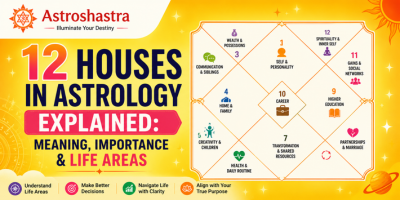
Learn the meaning of the 12 houses in astrology, what each house represents, and how they influence your life, career, r...
Read More
Discover powerful mantras for planets in Vedic astrology. Learn Navgraha mantras for Sun, Moon, Mars, Mercury, Jupiter, ...
Read More
Discover the effects of Venus Transit into Virgo on 1 August 2026. Learn how this important Vedic astrology transit will...
Read More
Discover how astrology may impact stock market success. Learn the connection between planetary positions, financial inst...
Read More
Discover the spiritual significance of Ashtavinayak, the eight sacred forms of Lord Ganesha located across Maharashtra. ...
Read More