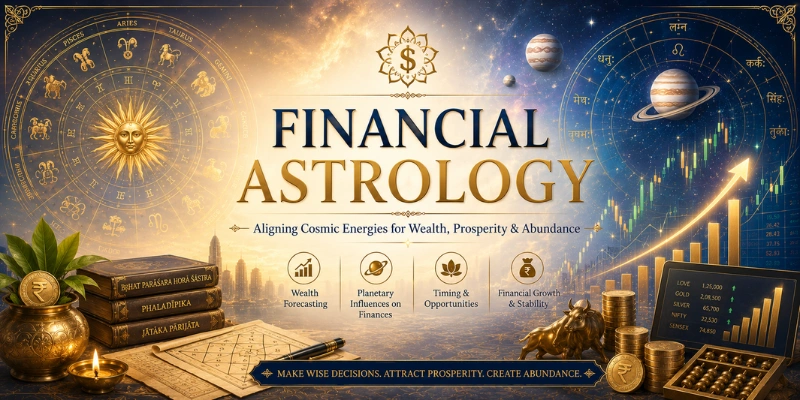
Learn a structured Vedic astrology method for studying stock market trends using planetary cycles, transits, houses, Nakshatras, Dashas and market timing.
Key Takeaways
- Define the market instrument and forecast period before interpreting any planetary signal.
- Combine long-cycle planets, faster transits and relevant Vedic timing factors instead of relying on one placement.
- Separate a possible market scenario from a guaranteed price prediction.
- Validate the method historically and compare it with financial, economic and risk-management information.
- What Is Stock Market Prediction in Financial Astrology?
- Step 1: Define the Market and Time Horizon
- Step 2: Study the Market Chart or Reference Framework
- Step 3: Examine Major Planetary Cycles
- Step 4: Add Short-Term Transits
- Step 5: Study Houses, Lords and Planetary Strength
- Step 6: Use Nakshatras and Lunar Factors for Finer Timing
- Step 7: Combine the Signals Instead of Counting Planets
- How to Validate a Stock Market Astrology Prediction
- Final Prediction Checklist
- Practical Research Checklist
What Is Stock Market Prediction in Financial Astrology?
Stock market prediction through astrology is a traditional interpretive approach in which planetary cycles, signs, houses, transits and other timing factors are studied for possible market themes. The objective is not simply to identify a lucky planet. A serious method attempts to define the market being studied, the forecast period, the expected type of movement and the astrological factors supporting that interpretation.
For Astroshastra readers, the most useful distinction is between a symbolic forecast and a guaranteed result. Financial markets respond to earnings, interest rates, policy, global events, liquidity, investor positioning and unexpected news. Astrology can therefore be presented as a traditional analytical layer rather than a substitute for economic or financial research.
Step 1: Define the Market and Time Horizon
Begin every prediction by defining exactly what is being studied. Nifty, Sensex, a sector index, a single stock and a personal investment portfolio are different subjects. A forecast should also state whether the period is a trading day, week, month, quarter or longer cycle. Without these boundaries, a prediction becomes too vague to test.
The time horizon should match the planetary factors being used. Fast-moving factors may be examined for shorter-term sentiment, while slow-moving planets can be studied for broader cycles. The key is consistency: use the same rules before and after the market movement so that the method can be evaluated rather than adjusted retrospectively.
Step 2: Study the Market Chart or Reference Framework
Traditional financial astrology may use a chart for a market, exchange, index or significant financial event. The chosen reference chart should be documented clearly because changing the reference point can change the interpretation. Some practitioners also examine the horoscope of the country's economic or political framework when making broader observations.
The useful question is not which chart is universally correct, but whether the chosen framework is applied consistently. Record the chart, date, time, location and house system used. Then compare the same framework against historical market phases. This creates a research trail and reduces selective interpretation.
Step 3: Examine Major Planetary Cycles
Start with the slower planetary cycles before moving to short-term details. Saturn, Jupiter, Rahu and Ketu can be studied as background influences because their movements develop over longer periods. Their relationships with sensitive points in the reference chart can be interpreted as periods of structural change, expansion, pressure or uncertainty.
This does not mean that a particular planet automatically produces a bull or bear market. The interpretation depends on the chart, house ownership, aspects and other simultaneous factors. A strong method therefore records both supportive and challenging signals instead of selecting only the factor that agrees with the desired forecast.
Step 4: Add Short-Term Transits
After the background cycle is established, faster planetary movements can be used to examine shorter windows. Mercury, Venus, Mars and the Sun may be considered for changes in activity, communication, confidence, competition or market attention. The Moon can be used when the method includes short-term sentiment or daily timing.
Short-term signals should be treated as modifiers rather than independent proof. If a long-term period appears stable but a fast transit is tense, the interpretation may be increased volatility inside an otherwise stable trend rather than an immediate market reversal. This layered approach is more useful than assigning one fixed meaning to every transit.
Step 5: Study Houses, Lords and Planetary Strength
In a Vedic framework, houses provide context. The 2nd and 11th houses are commonly discussed in relation to resources and gains, while the 5th can be relevant to speculation. The 8th may be examined for sudden changes, and the 10th for institutions, public activity and professional structures. Which houses matter most depends on the reference chart.
House lordship also matters. A planet should not be interpreted only by its natural symbolism. Its sign, house, dignity, aspects, conjunctions and functional role can modify the reading. This is one reason a detailed financial astrology article should avoid simple claims such as 'Jupiter always means profit' or 'Saturn always means a fall.'
Step 6: Use Nakshatras and Lunar Factors for Finer Timing
Nakshatras can add a finer layer to a Vedic astrology analysis, particularly when the Moon and planetary positions are being used for timing. A practitioner may examine the Nakshatra occupied by an important planet, the movement of the Moon through relevant Nakshatras, or the relationship between a transit and sensitive chart points.
Lunar factors should not be isolated from the larger cycle. A short Nakshatra-based signal can be useful for identifying a review window, but it should not automatically override a broader planetary trend. Recording the exact rule used makes the analysis easier to study later.
Step 7: Combine the Signals Instead of Counting Planets
A market prediction becomes more disciplined when signals are weighted by relevance. A slow-moving transit affecting a major chart point may deserve more attention than several minor short-term observations. Likewise, repeated indications from independent factors can strengthen a hypothesis, while contradictory signals should be reported openly.
A practical research table can contain four columns: factor, interpretation, expected market behaviour and confidence level. For example, a long-term Saturn contact might suggest caution, while a supportive Jupiter factor may suggest resilience. The conclusion can then be 'cautious with possible volatility' instead of forcing a binary bullish or bearish answer.
How to Validate a Stock Market Astrology Prediction
Prediction quality should be evaluated against historical data. Before looking at the outcome, write the forecast, date range, market instrument, expected direction and what would count as confirmation or failure. After the period ends, record what actually happened. This prevents hindsight from turning an ambiguous statement into an apparent success.
A useful journal can track false positives, false negatives and periods where the method gave no clear signal. If a rule works only after being changed repeatedly, it should not be presented as a reliable forecasting method. Transparency about uncertainty makes financial astrology more educational and credible.
Final Prediction Checklist
Before publishing or acting on a market astrology forecast, check: the market instrument is defined; the forecast period is explicit; the reference chart is documented; slow and fast transits have been separated; relevant houses and lords have been reviewed; conflicting signals have been acknowledged; and financial fundamentals have not been ignored.
The final output should describe a scenario rather than promise an outcome. For example, a forecast may identify a period of increased volatility and recommend closer risk monitoring. That is more responsible than claiming a planetary configuration guarantees a market rise or crash.
Practical Research Checklist
Use a written research checklist before making the forecast. Record the instrument, reference chart, start and end dates, planetary factors, relevant houses, expected scenario and invalidation condition. Then record what actually happened. This makes the article useful as an evergreen methodology guide rather than a one-time prediction.
For investors, the checklist should also include conventional evidence: company or index fundamentals, valuation, macroeconomic conditions, liquidity, major corporate or policy events, position size and maximum acceptable loss. The astrological interpretation should remain a separate layer so that a symbolic signal does not override financial suitability.
Astroshastra Editorial Note
This article presents traditional Vedic astrology concepts as an educational framework for financial-market study. Astrology is not a scientifically established method for predicting security prices or guaranteed investment returns. Readers should use independent financial research and appropriate professional advice before making investment decisions.
How to Predict Stock Market Trends Using Astrology – FAQs
Common questions about stock market prediction astrology and traditional financial astrology.
Can astrology predict the stock market with certainty?
No. Astrology is a traditional interpretive framework and cannot guarantee market direction, prices or investment returns. Market outcomes are affected by many economic, financial and unexpected factors.
Which planets are important for stock market prediction?
Practitioners commonly examine Saturn, Jupiter, Rahu, Ketu, Mars, Mercury, the Sun, Venus and the Moon. Their importance depends on the reference chart and the specific prediction being studied.
Which houses are studied for stock market prediction?
The 2nd, 5th, 8th, 10th and 11th houses are commonly considered, with the exact emphasis depending on the chart and the question.
Can this method be used for Nifty and Sensex?
A traditional financial astrology approach can be applied to market or index reference charts, but the result should be treated as an interpretive forecast rather than a guaranteed index prediction.
Should astrology replace fundamental analysis?
No. Company financials, valuation, business quality, economic conditions and risk management remain essential parts of an investment decision.