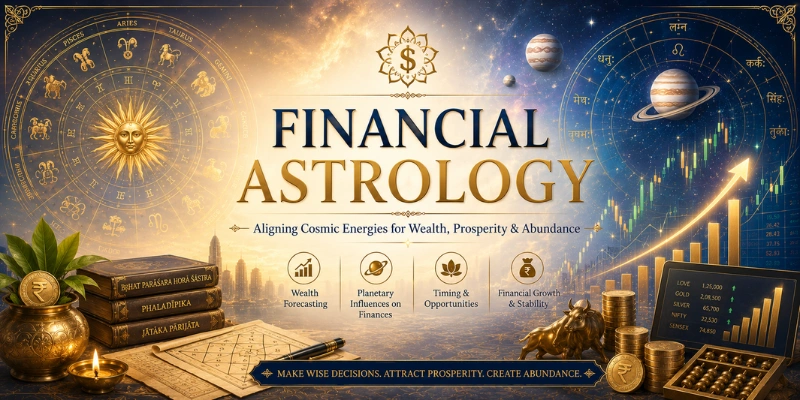
A structured guide to studying Nifty and Sensex trends with Vedic financial astrology, including reference charts, planetary transits, volatility and timing.
Key Takeaways
- Define the market instrument and forecast period before interpreting any planetary signal.
- Combine long-cycle planets, faster transits and relevant Vedic timing factors instead of relying on one placement.
- Separate a possible market scenario from a guaranteed price prediction.
- Validate the method historically and compare it with financial, economic and risk-management information.
- Why Nifty and Sensex Need a Market-Level Method
- Choose and Document the Reference Chart
- Study the Major Background Cycle
- Examine the 2nd, 5th, 8th and 11th Houses
- Use Jupiter and Saturn as Long-Cycle Anchors
- Add Mars, Mercury, Venus, Sun and Moon
- Bullish, Bearish and Neutral Scenarios
- How to Study Nifty and Sensex Historical Accuracy
- Practical Market-Research Layer
- How to Present a Nifty or Sensex Forecast
- Practical Research Checklist
Why Nifty and Sensex Need a Market-Level Method
Nifty and Sensex represent broad baskets of companies, so an index forecast is different from reading an individual's investment Kundli. The analysis needs a market-level reference point and a clearly defined period. The purpose is to study broad themes such as trend persistence, volatility, expansion, contraction and turning-point risk.
A market index can move even when individual sectors behave differently. Therefore, a market-level astrology method should be supplemented with sector analysis and financial data. Astrology can provide a symbolic timing framework, while economic and market research helps explain the actual drivers.
Choose and Document the Reference Chart
Before making a Nifty or Sensex prediction, document the reference framework being used. This can be a chart associated with the market, index launch or another clearly defined financial event. The exact date, time and location should be recorded and kept consistent for future studies.
There is no value in changing the reference chart whenever the result does not match expectations. A consistent chart makes historical testing possible. If more than one reference framework is used, keep the outputs separate instead of combining them selectively.
Study the Major Background Cycle
Begin with Saturn, Jupiter, Rahu and Ketu. Their long-duration movements can be used to identify broad phases for the market reference chart. Supportive patterns may be interpreted as periods in which confidence or expansion could be more prominent, while difficult contacts may be studied as periods requiring greater caution or attention to volatility.
The conclusion should remain conditional. A challenging transit does not automatically equal a crash, and a supportive transit does not automatically equal a sustained rally. The interaction of multiple factors matters more than a single planetary label.
Examine the 2nd, 5th, 8th and 11th Houses
The 2nd house can be considered for resources and financial stability, the 5th for speculation, the 8th for sudden changes and the 11th for gains. The 10th house may also be relevant to public institutions and economic activity. Examine the house lords and the planets influencing these houses rather than relying only on house names.
This framework helps separate different market behaviours. For example, a strong 11th-house theme may be discussed as a gains-related factor, while simultaneous 8th-house activation may suggest abrupt changes. The final interpretation should describe the combination rather than isolate one house.
Use Jupiter and Saturn as Long-Cycle Anchors
Jupiter is traditionally associated with growth, knowledge and expansion, while Saturn is associated with structure, restraint, discipline and long-term processes. When studying a market index, their transits can provide a broad context for the shorter-term signals.
A useful method is to first write the Jupiter-Saturn background interpretation and only then add fast planets. This reduces the tendency to make a major market call based on a short transit that may have little influence on the broader cycle.
Add Mars, Mercury, Venus, Sun and Moon
Faster planets can be used to refine a time window. Mars may be studied for aggressive activity or conflict themes, Mercury for information and trading activity, Venus for value and sentiment, and the Sun for authority and public focus. The Moon can be considered for short-duration sentiment or daily timing.
These meanings are symbolic and should be used consistently. A fast transit should generally be treated as a timing modifier rather than as sufficient evidence for a major index reversal.
Bullish, Bearish and Neutral Scenarios
Instead of forcing every period into 'Nifty will rise' or 'Nifty will fall', create three scenarios: supportive, neutral and risk-heavy. Record the astrological factors supporting each scenario and then identify which one has the strongest evidence.
This approach is especially useful for market content because real markets can move sideways, experience sharp intraday volatility or rotate between sectors without establishing a clear trend. A neutral forecast can be a valid result when the astrological signals are mixed.
How to Study Nifty and Sensex Historical Accuracy
Historical testing should use a predefined rule set. Select past periods, calculate the same planetary factors, write the expected scenario and compare the result with actual index behaviour. Do not modify the rule after seeing the result and then count the period as a success.
Track the size and duration of moves rather than merely asking whether the index closed up or down. A prediction of increased volatility should be evaluated differently from a directional prediction. This makes the research more meaningful.
Practical Market-Research Layer
Astrological timing should be compared with earnings seasons, interest-rate decisions, inflation, crude oil, currency movement, global indices, institutional flows and major policy events. These variables can have immediate effects on Indian indices.
The strongest educational content therefore shows both layers. Astrology can identify a period to watch, while market research identifies the fundamental reasons why that period may be important.
How to Present a Nifty or Sensex Forecast
A professional forecast should state the index, date range, astrological basis, expected scenario, uncertainty and risk-management considerations. Avoid language that implies certainty or guaranteed returns. Explain what would make the forecast invalid.
This format also creates stronger evergreen content because readers learn the method rather than receiving a one-time prediction that becomes outdated as soon as the market moves.
Practical Research Checklist
Use a written research checklist before making the forecast. Record the instrument, reference chart, start and end dates, planetary factors, relevant houses, expected scenario and invalidation condition. Then record what actually happened. This makes the article useful as an evergreen methodology guide rather than a one-time prediction.
For investors, the checklist should also include conventional evidence: company or index fundamentals, valuation, macroeconomic conditions, liquidity, major corporate or policy events, position size and maximum acceptable loss. The astrological interpretation should remain a separate layer so that a symbolic signal does not override financial suitability.
Astroshastra Editorial Note
This article presents traditional Vedic astrology concepts as an educational framework for financial-market study. Astrology is not a scientifically established method for predicting security prices or guaranteed investment returns. Readers should use independent financial research and appropriate professional advice before making investment decisions.
How to Predict Nifty and Sensex Using Vedic Astrology – FAQs
Common questions about nifty sensex astrology prediction and traditional financial astrology.
Can Vedic astrology predict Nifty exactly?
No. It can be used as a traditional interpretive framework for studying market periods, but it cannot guarantee exact index levels or returns.
Should Nifty and Sensex be analysed separately?
Yes. They are different indices with different compositions and reference histories, so a rigorous study should keep their frameworks separate.
Which planets are most important for Nifty prediction?
Slow-moving planets can be used for broad cycles and faster planets for timing. The importance of each planet depends on the chosen market reference chart.
Can astrology predict a Nifty crash?
Astrology may be used by practitioners to identify periods they consider tense or volatile, but a crash should never be presented as a guaranteed outcome.
What should be checked with an astrology forecast?
Economic conditions, valuation, global markets, corporate earnings, liquidity, policy decisions and your own risk tolerance should also be considered.