
Om Namah Shivaya Explained: Meaning, Significance, Benefits & How to Chant
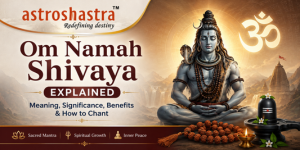
Simple in pronunciation yet profound in meaning, this mantra has been recited by devotees for centuries as a spiritual practice for inner purification, devotion and connection with Shiva consciousness.
The mantra is traditionally known as the Panchakshari Mantra, referring to its five principal syllables: Na-Ma-Shi-Va-Ya. When Om is added at the beginning, it becomes the widely practiced form Om Namah Shivaya.
Whether you are beginning your spiritual journey or already practice Shiva upasana, understanding the meaning behind this mantra can make its chanting more meaningful.
What Does Om Namah Shivaya Mean?
The mantra can be understood as:
Om Namah Shivaya
- Om – the primordial sacred sound, associated with the ultimate reality and cosmic consciousness.
- Namah – a respectful salutation, surrender or bowing.
- Shivaya – to Shiva, the auspicious and benevolent divine principle.
Thus, in a devotional sense, Om Namah Shivaya can be understood as:
“I bow to Shiva.”
It also conveys the deeper idea of surrendering the ego and turning one's awareness toward the auspicious, transformative consciousness represented by Lord Shiva.
Why Is Om Namah Shivaya Called the Panchakshari Mantra?
The core mantra is:
Namah Shivaya
It contains five syllables:
Na – Ma – Shi – Va – Ya
Therefore, it is traditionally called Panchakshari, meaning “five-syllabled.”
The addition of Om gives the commonly recited form:
Om Namah Shivaya
In Shaiva traditions, the five syllables are also associated symbolically with the five elements:
| Syllable | Element |
|---|---|
| Na | Earth |
| Ma | Water |
| Shi | Fire |
| Va | Air |
| Ya | Space |
This symbolic association gives the mantra an important place in traditional spiritual practices involving purification and harmony.
Spiritual Significance of Om Namah Shivaya
The importance of this mantra goes beyond simply repeating a sacred phrase.
Lord Shiva represents several profound spiritual principles, including transformation, detachment, consciousness and liberation.
When a devotee chants Om Namah Shivaya, the practice can serve as a reminder to:
- surrender the ego
- cultivate inner stillness
- develop devotion
- release negative thoughts
- become more self-aware
- accept transformation
- turn the mind inward
The mantra therefore becomes not only an expression of devotion but also a tool for contemplation.
What Are the Benefits of Chanting Om Namah Shivaya?
Traditional Hindu practice associates Shiva mantra japa with spiritual purification, devotion and mental steadiness.
Regular chanting may help practitioners develop:
1. Inner Peace
Repetitive mantra chanting can provide a rhythmic focus for the mind and create a peaceful meditation practice.
2. Better Concentration
Keeping attention on the sound and pronunciation of the mantra can help reduce mental distraction during spiritual practice.
3. Emotional Balance
The devotional nature of Shiva mantra chanting may help practitioners cultivate patience, acceptance and inner composure.
4. Spiritual Purification
In traditional belief, chanting the Panchakshari Mantra is associated with purification of the mind and consciousness.
5. Deeper Devotion to Lord Shiva
For Shiva devotees, repeating the mantra provides a simple way to maintain remembrance of Shiva throughout daily life.
6. Support for Meditation
Because the mantra is short and repetitive, it can be used as a japa or meditation mantra, allowing attention to gradually become more focused.
These benefits should be understood primarily as traditional spiritual and contemplative benefits rather than as guaranteed medical effects.
How to Chant Om Namah Shivaya Correctly
There is no need for elaborate arrangements to begin mantra japa.
A simple practice can be:
- Sit comfortably in a clean and peaceful place.
- Keep your spine reasonably straight.
- Take a few slow breaths.
- Bring your attention toward Lord Shiva.
- Chant Om Namah Shivaya slowly and clearly.
- Listen carefully to the sound as you repeat it.
- Try to keep your mind focused on the mantra.
- Continue for a chosen number of repetitions.
- End the practice with a moment of silence and gratitude.
The most important aspect is devotion, attention and regularity rather than simply counting repetitions.
How Many Times Should You Chant Om Namah Shivaya?
There is no single number that every devotee must follow.
Common japa practices may include:
- 11 repetitions
- 21 repetitions
- 27 repetitions
- 54 repetitions
- 108 repetitions
Many devotees use a 108-bead mala for mantra japa.
If you are a beginner, starting with a small number of repetitions and gradually developing a regular practice can be easier than attempting a large number immediately.
Can You Chant Om Namah Shivaya Every Day?
Yes. Om Namah Shivaya is commonly practiced as a daily Shiva mantra.
You can chant it:
- in the morning
- during meditation
- during evening prayer
- after bathing
- while performing Shiva puja
- during personal spiritual practice
Some devotees also mentally repeat the mantra during quiet moments throughout the day.
What Is the Best Time to Chant Om Namah Shivaya?
Traditional Shiva worship gives particular importance to early morning and Pradosh periods.
For personal japa, however, consistency is often more practical than focusing exclusively on a particular clock time.
A peaceful morning practice can be especially suitable because the mind may be less occupied by the day's activities.
Monday, Pradosh, and Maha Shivaratri are particularly significant occasions for Shiva worship.
Can Om Namah Shivaya Be Chanted During Shravan?
Yes. Shravan month is traditionally considered especially sacred for devotees of Lord Shiva.
During Shravan, many devotees increase their Shiva worship through:
- Om Namah Shivaya japa
- Rudrabhishek
- Shiva Puja
- fasting
- visiting Shiva temples
- offering Bilva leaves
- meditation and prayer
The mantra can therefore become a simple daily spiritual practice throughout Shravan.
Om Namah Shivaya and the Five Elements
The five syllables of Namah Shivaya are traditionally connected with the five great elements:
Na – Earth
Ma – Water
Shi – Fire
Va – Air
Ya – Space
This interpretation gives the mantra a symbolic connection with the entire material creation.
From this perspective, chanting becomes a reminder of the relationship between the individual, nature and the greater cosmic reality.
Om Namah Shivaya and the Mind
One reason mantra meditation has remained popular for generations is its repetitive nature.
Instead of allowing the mind to constantly jump from one thought to another, the practitioner repeatedly returns attention to one sound.
With regular practice, this can become a simple form of concentration and contemplation.
The goal is not merely to pronounce the words repeatedly, but gradually to develop awareness of the mantra and the state of mind accompanying it.
Can Beginners Chant Om Namah Shivaya?
Yes.
One of the reasons this mantra is so widely practiced is its simplicity.
A beginner does not necessarily need elaborate knowledge of Sanskrit, complicated rituals or an elaborate altar to begin.
Start slowly, pronounce the mantra respectfully, and focus on its meaning.
As your practice develops, you can explore more structured forms of Shiva worship and japa under the guidance of a knowledgeable teacher.
Om Namah Shivaya with Rudraksha Mala
Rudraksha has a particularly strong traditional association with Lord Shiva.
Devotees often use a Rudraksha Mala for Shiva mantra japa, commonly completing 108 repetitions.
The mala can help maintain a consistent count while also making the practice more mindful and disciplined.
However, the spiritual value of the practice does not depend solely on possessing a particular mala. The sincerity and concentration with which the mantra is practiced remain important.
Om Namah Shivaya: Mantra vs. Mechanical Repetition
Simply repeating a mantra very quickly while thinking about unrelated matters is different from mindful japa.
For a deeper practice, try to combine:
Sound + Meaning + Awareness + Devotion
Instead of rushing through 108 repetitions, a slower and attentive practice may be more meaningful for many practitioners.
Common Mistakes While Chanting Om Namah Shivaya
Some common mistakes include:
Chanting Too Quickly
The mantra should not become an unintelligible string of sounds.
Ignoring the Meaning
Understanding the meaning can make devotional chanting more conscious.
Treating It as a Guaranteed Cure
Mantra practice is a spiritual tradition and should not be presented as a guaranteed treatment for medical or psychological conditions.
Focusing Only on Numbers
Completing a specific number of repetitions can provide discipline, but the quality of attention is also important.
Expecting Instant Results
Spiritual practices traditionally emphasize regularity and patience.
Om Namah Shivaya in Daily Life
You do not necessarily need a long meditation session every time you chant.
You can establish a simple daily routine:
Morning: 11 or 21 repetitions
Evening: 11 or 21 repetitions
Monday: Extended Shiva japa or puja
Pradosh: Shiva worship and mantra meditation
Maha Shivaratri: Extended spiritual practice
The purpose is to gradually make remembrance of Shiva a natural part of daily life.
The Deeper Message of Namah Shivaya
Perhaps the deepest significance of Namah Shivaya lies in the word Namah—the act of bowing or surrendering.
In spiritual practice, surrender does not necessarily mean giving up one's responsibilities.
Instead, it can mean reducing ego, accepting reality with greater awareness and dedicating one's actions to a higher principle.
The mantra therefore carries a message of:
Devotion, surrender, transformation and inner awareness.
Om Namah Shivaya is much more than a popular Shiva mantra. Its five-syllabled core, Namah Shivaya, has a profound place in Shaiva spiritual traditions.
For devotees, chanting the mantra can become a daily practice of remembrance, devotion and meditation. Whether repeated 11 times, 108 times with a Rudraksha Mala, or mentally remembered throughout the day, the essence remains the same: turning one's awareness toward Shiva.
The real power of the practice lies not merely in the number of repetitions but in the faith, awareness, understanding and sincerity with which the mantra is chanted.
Om Namah Shivaya.
FAQ
1. What does Om Namah Shivaya mean?
Om Namah Shivaya is a sacred mantra dedicated to Lord Shiva and can be understood devotionally as “I bow to Shiva.”
2. Why is Namah Shivaya called the Panchakshari Mantra?
Namah Shivaya consists of five principal syllables—Na, Ma, Shi, Va and Ya—so it is traditionally known as the Panchakshari Mantra.
3. What are the benefits of chanting Om Namah Shivaya?
Traditional practice associates the mantra with devotion, mental focus, inner peace, spiritual purification and meditation.
4. How many times should Om Namah Shivaya be chanted?
Devotees may chant it 11, 21, 54 or 108 times, depending on their personal practice. There is no universal compulsory number.
5. Can Om Namah Shivaya be chanted every day?
Yes. It is commonly practiced as a daily Shiva mantra during morning prayer, meditation or personal japa.
6. Can Om Namah Shivaya be chanted during Shravan?
Yes. Shravan is traditionally considered an auspicious period for Shiva worship and mantra japa.
7. Can I chant Om Namah Shivaya with a Rudraksha Mala?
Yes. Rudraksha malas are traditionally associated with Shiva worship and are commonly used for mantra japa.
8. What is the best time to chant Om Namah Shivaya?
Early morning is traditionally considered suitable for meditation and japa. Mondays, Pradosh and Maha Shivaratri are also significant for Shiva worship.
Comments