
Lord Kamadeva: The Hindu God of Love, Desire, and Attraction
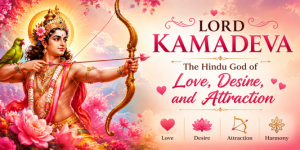
In Hindu mythology, the divine force of love, attraction, beauty, and desire is personified by Lord Kamadeva, the celestial God of Love. Often compared to Cupid in Greek mythology, Kamadeva plays a significant role in maintaining the cycle of creation by inspiring love and affection among living beings.
Known for his charming appearance, floral bow, and arrows of desire, Lord Kamadeva symbolizes not only romantic love but also the universal force that drives creation and emotional connection.
Who is Lord Kamadeva?
Lord Kamadeva, also known as Kamdev, Manmatha, Madana, Kandarpa, and Ananga, is the Hindu deity associated with love, attraction, passion, desire, and fertility. He is considered the divine embodiment of Kama, one of the four Purusharthas (goals of human life) in Hindu philosophy.
The four Purusharthas are:
- Dharma (Righteousness)
- Artha (Wealth)
- Kama (Desire and Pleasure)
- Moksha (Liberation)
Kamadeva represents the healthy and balanced pursuit of love, relationships, beauty, and emotional fulfillment.
The Appearance of Lord Kamadeva
Ancient scriptures describe Lord Kamadeva as an exceptionally handsome and youthful deity adorned with beautiful ornaments and fragrant flowers.
His distinctive features include:
- A bow made of sugarcane
- A string made of honeybees
- Five flower arrows
- A parrot as his vehicle
- Spring season (Vasant Ritu) as his companion
These symbols emphasize sweetness, attraction, beauty, and the blossoming nature of love.
The Five Flower Arrows of Kamadeva
Lord Kamadeva's arrows are not made of metal but flowers. Each arrow represents a different aspect of emotional and romantic attraction.
The five arrows are traditionally associated with:
- Attraction
- Infatuation
- Passion
- Emotional Bonding
- Deep Love
When Kamadeva releases these arrows, they awaken feelings of affection, romance, and longing in the hearts of beings.
Kamadeva and Goddess Rati
Lord Kamadeva is married to Goddess Rati, who is regarded as the goddess of love, romance, beauty, pleasure, and sensuality.
Rati symbolizes devotion and emotional intimacy in relationships. Together, Kamadeva and Rati represent the harmonious union of attraction and affection, emphasizing that true love is more than physical desire—it includes emotional connection, loyalty, and mutual respect.
The Famous Story of Kamadeva and Lord Shiva
One of the most popular legends involving Lord Kamadeva is connected with Lord Shiva and Goddess Parvati.
After the death of Goddess Sati, Lord Shiva entered deep meditation and became detached from worldly affairs. Meanwhile, the demon Tarakasura had become powerful and could only be defeated by a son born to Shiva.
The gods approached Kamadeva and requested him to awaken feelings of love in Lord Shiva's heart for Goddess Parvati.
Kamadeva courageously aimed his flower arrow at Shiva while the great deity was meditating. Disturbed from his meditation, Lord Shiva opened his third eye in anger and reduced Kamadeva to ashes instantly.
The devastated Goddess Rati prayed for her husband's restoration. Moved by her devotion, Lord Shiva later granted Kamadeva life again but without a physical body. This is why Kamadeva is often called Ananga, meaning "the bodiless one."
This story symbolizes that desire can be transcended through spiritual discipline, yet it remains an essential force in creation.
Kamadeva as Ananga
The name Ananga means "without a body."
After being burned by Shiva's third eye, Kamadeva continued to exist as an invisible force influencing the hearts and minds of living beings.
This concept highlights an important spiritual truth:
Love and desire are powerful energies that cannot be destroyed completely; they can only be transformed and elevated.
Kamadeva in Hindu Scriptures
References to Lord Kamadeva can be found in several Hindu texts, including:
- Rig Veda
- Atharva Veda
- Mahabharata
- Shiva Purana
- Matsya Purana
- Skanda Purana
- Bhagavata Purana
The Vedas describe Kama as one of the primordial forces that emerged during creation, indicating the cosmic importance of desire and attraction in the universe.
Spiritual Significance of Kamadeva
Many people mistakenly associate Kamadeva solely with physical attraction. However, Hindu philosophy presents a deeper perspective.
Kamadeva symbolizes:
Creative Energy
Desire motivates growth, creativity, relationships, and family life.
Emotional Connection
Love forms the foundation of social harmony and human relationships.
Balance in Life
Kama is recognized as a legitimate goal of life when pursued ethically and responsibly.
Transformation of Desire
Spiritual practices teach that worldly desires can ultimately be transformed into divine love and devotion.
Worship of Lord Kamadeva
Although dedicated temples of Lord Kamadeva are relatively rare, he is worshipped during festivals associated with love, fertility, marriage, and spring.
Devotees may seek his blessings for:
- Happy relationships
- Marital harmony
- Emotional fulfillment
- Attraction and affection between partners
- Fertility and family happiness
His worship is often performed alongside Goddess Rati.
Kamadeva and the Festival of Holi
In several regions of India, Kamadeva is associated with the arrival of spring and the festival of Holi.
The colorful celebration of Holi reflects themes closely linked to Kamadeva:
- Joy
- Romance
- Renewal
- Love
- Celebration of life
The blooming of flowers and the onset of spring symbolize the awakening of love and desire throughout nature.
Lessons from Lord Kamadeva
The mythology of Kamadeva teaches several important lessons:
- Love is a divine force.
- Desire should be guided by wisdom and ethics.
- Emotional connection is essential for healthy relationships.
- Spiritual growth requires mastery over uncontrolled desires.
- True love combines attraction, devotion, and respect.
Lord Kamadeva occupies a unique place in Hindu mythology as the divine embodiment of love, attraction, desire, and emotional fulfillment. His story with Goddess Rati and Lord Shiva illustrates the delicate balance between worldly desires and spiritual evolution.
Far beyond mere romance, Kamadeva represents the universal force that inspires creation, relationships, beauty, and the continuation of life itself. His teachings remind us that love, when guided by wisdom and righteousness, becomes a sacred path toward harmony, happiness, and ultimately, spiritual growth.