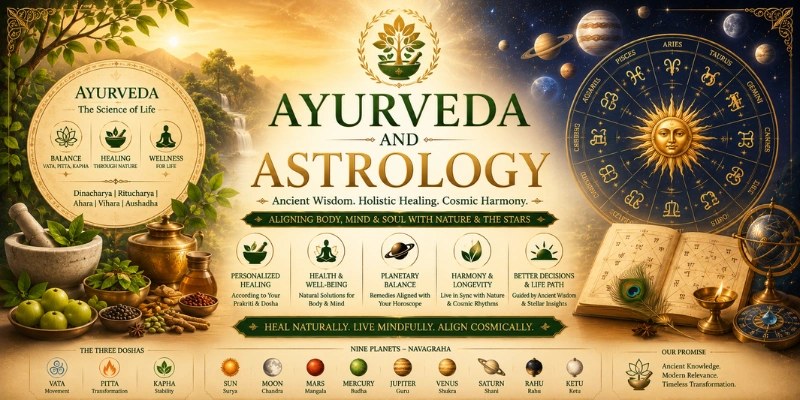
Astrology and Ayurveda , both are the parts of Vedas . Both have their
roots in the same Indian Vedic tradition. Both, the science of correlation of heavenly bodies with human existence, both these sciences are greatly
intertwined with each other, and often one of them corroborates or even supplements the other. For this reason, several Ayurvedic vaidyas have looked
upon Astro as a supplement to their prescriptions, and several astrologists have tried to rectify planetary maladies with the help of both.
It is the science of planetary movements. There are about thirty slokas in the Rig Veda, fourty four in Yajura Veda and one hundred and sixty two in
Atharva
Veda. It is the science of the influence of the planets and stars on human and terrestrial affairs. In the Indian scriptures, Jyotish Shastra is one of the
six disciplines required for the proper understanding of the Vedas, which are known as the Vedangas. The other five Vedangas are:-Shiksha – Study of Phonetics,
Chanda – Study of Meter, Vyakarana – Study of Grammar, Nirukta – Study of Etymology, Kalpa – Study of the Rituals
Ayurveda is part of AtharvaVeda. There are three texts on Charaka Samhita, the Sushruta Samhita and the Bhela Samhita.It is the system of Indian healing that has been
practised in India for thousands of years.
DOSHAS IN AYURVEDA AND SUNSIGNS IN ASTROLOGY
It is based on the three constitutions, the three dosha's. These three dosha's are called
vata, pitta and kapha. Vata corresponds to air, pitta to fire,
and kapha to earth and water. The astrological signs, are divided in these three Doshas:
•
Vata : Gemini, Virgo, Libra, Capricorn and Aquarius. Virgo is placed here because it is ruled by Mercury, which is an air planet. Capricorn is mentioned
here because it is ruled by the vata planet Saturn.
•
Pitta : Aries, Leo, Sagittarius and Scorpio. Scorpio is pitta because the classic ruler of Scorpio is the fire planet Mars. Uranus, Neptune and Pluto
are not used, and so Mars remains the ruler of Scorpio.
•
Kapha : Taurus, Cancer, and Pisces. These are the earth and water signs not assigned to vata and pitta.
CHARACTERISTICS OF THE DOSHA'S:
• A vata type is generally slim (thin), has difficulty concentrating, feels the cold and has a great urge to be quickly satisfied in his needs. He eats quickly, chews his
food badly and eats at irregular hours.
• A kapha type is often corpulent, slow, and has a calm, thoughtful character. He eats a lot and enjoys his food.
• A pitta type has a well-balanced figure, likes action and can be hot tempered. Because his life is so busy, he may feel food is not very important.
Vata means wind and has the elements of ether and air. Pitta means bile and has the elements of fire and water. Kapha means phlegm and has the elements of water and earth.
Each Dosha has its natural qualities, and as with the Gunas of Ayurveda there are foods that are associated with each Dosha:
Qualities:
• Vata: cold, dry, light, moving, flighty, spiritual, thin
• Pitta: hot, oily, light, fiery, vibrant, successful, aggressive
• Kapha: cool, oily, heavy, stable, slow, methodical, greedy
Foods/Tastes:
• Vata: bitter, astringent, pungent/spicy, raw
• Pitta: sour, pungent/spicy, salty, fetid, warm
• Kapha: sweet, salty, sour, creamy, heavily cooked
In our birth charts the Doshas of our Ascendant, its ruling planet, and the ruler of the sixth house (health, disease, and hygeine) can give us a heads-up to potential
imbalances in our bodies.
Medical astrology scientifically studies planetary movements and their effect on human constitutions and lives. It is based on the concept that each planet is intrinsically
related to a specific body tissue and that the various planetary movements and their positions in relation to time exert powerful influences on your mind, body and
consciousness, directly affecting your physical and mental health. It is to be noted that sun, rahu & ketu are nodal points exactly opposite each other and are given the
status of planets. They are important indicators of spiritual and / or materialistic tendencies.
There are Nine Planets (as per ancient literature in Jyotish), which has got a capacity to rule over our life.
They occupy different places in our Natal chart (JanmaKundali). According to their specific location in natal chart, they decide several factors with reference to our life
viz. Our Nature and Behaviour (Swabhava and Prakruti), Disorders (Roga/Vyadhi) etc. So by looking at ones natal chart one can predict several things with special reference
to both as well.
It accepts the therapy of
PANCHAMAHABHOOTAS. Therefore the Nine planets about whom we have discussed before can also be co-related with there five Basic
Elelments and they are as follows:
There are references available with specific respect to the co-relation of planets
and the Vital Body tissues (Dhatus) of the Human body also. These dhatus are considered to be an important component of forming of body (Sharira).
Associated with planetary influences are the ailments affecting the portion of the body represented by the Sign position of the planet - at birth, in transit, or by direction;
and by the Signs and Houses ruled by the planet.
Medical Astrology & Planetary Health Associations
Traditional Vedic Astrology References for Planetary Influences on Health
| Planet |
Traditional Health Associations |
| ☀ Sun |
Ailments traditionally associated with the heart, upper spine, circulation, fevers, spleen disorders, tissue degeneration, anaemia and indigestion. |
| 🌙 Moon |
Traditionally linked with emotional imbalance, mental instability, glandular disorders, allergies, female health concerns and mood fluctuations. |
| ♂ Mars |
Associated with inflammation, constipation, liver concerns, blood pressure irregularities, irritation, restlessness and vitality-related conditions. |
| ☿ Mercury |
Traditionally connected with nervous disorders, ulcers, acidity, communication-related stress and neurological imbalances. |
| ♃ Jupiter |
Linked with liver disorders, jaundice, digestive disturbances, chronic acidity, insomnia and metabolic imbalances. |
| ♀ Venus |
Associated with reproductive health, respiratory concerns, bronchial disorders, asthma and emotional obsessions. |
| ♄ Saturn |
Traditionally connected with chronic disorders, rheumatism, neuralgia, sciatica, fatigue and excretory issues. |
☊ Rahu
☋ Ketu |
Rahu: Hyperacidity, burning sensations, addictions and unusual health disturbances.
Ketu: Skin disorders, nervous weakness, urinary concerns and mysterious ailments.
|
Planetary Diseases & Traditional Ayurvedic Herbs
| Graha |
Traditional Disease Associations |
Associated Herb |
| Sun |
Inflammatory conditions, fevers, eye disorders, skin ailments and bone-related issues. |
Bilwamoola
Bael Tree (Aegle marmelos) |
| Moon |
Sleep disorders, coughs, digestive disturbances, blood-related disorders and emotional imbalances. |
Kharika
Cucumber (Cucumis sativus) |
| Mars |
Excessive heat, stomach ailments, fractures, skin irritation and inflammatory conditions. |
Bridhadwarakamoola |
| Mercury |
Nervous tension, throat disorders, skin diseases, poisoning and irrational fears. |
Anantmool
Indian Sarsaparilla |
| Jupiter |
Digestive disorders, tumors, chronic coughs, ear ailments and diseases linked with metabolism. |
Brahmajatimool |
| Venus |
Reproductive issues, relationship-related stress and disorders associated with comforts and pleasures. |
Shwetaberela Moola |
| Saturn |
Chronic fatigue, leg pain, mental stress, accidents and long-term health conditions. |
Shwetachandanmoola |
| Rahu |
Poisoning-related illnesses, hallucinations, fears and unusual health complications. |
Shwetachandanmoola |
| Ketu |
Mysterious or difficult-to-diagnose ailments according to traditional astrological literature. |
Ashwagandha
Winter Cherry |
Medical Astrology Disclaimer: The information presented here is based on traditional Vedic astrology and classical astrological texts. It is intended solely for educational, cultural, and spiritual purposes. Astrology is not a substitute for professional medical advice, diagnosis, or treatment. Always consult qualified healthcare professionals for any medical concerns.
Ayurvedic Knowledge Hub
Browse our collection of Ayurvedic articles and natural remedies.